
RESULTS: ENVIRONMENT |
||||
 |
||||
|
Climate and Development: A Double Dividend In 2008 the Swiss Agency for Development and Cooperation (SDC) launched four Global Programmes on climate change, food security, migration, and water. The Global Programmes devise innovative yet practical solutions in addressing these challenges. They contribute nationally and internationally to an informed political dialogue. A new SDC report on the Global Programme on Climate Change authored by Richard Gerster, Sonja Beeli and Konrad Matter shows that action on the ground yields a double dividend: alleviating poverty on the one hand, and addressing the causes and effects of climate change on the other. In the interests of maximum impact, the efforts focuse on only four countries: China, India, Peru and South Africa. The report structure follows that of the Global Programme itself, with sections on political dialogue, operational experience and knowledge-sharing. Key information on each topic is presented over two pages, together with an information graphic. It offers an insight how international cooperation can contribute to make globalisation more development oriented. The present report of the Global Programme on Climate Change draws on an internal audit entrusted to Gerster Consulting by the SDC in 2011. The report can be downloaded below in English, French and German. Hard copies can be ordered at SDC: jolanda.nasimauron@deza.admin.ch
|
Output
publication: 32 pp Author: Richard Gerster, Sonja Beeli, Konrad Matter Download PDF: - Climate and development: A Double Dividend - Réponse au changement climatique, co- Bénéfices pour le développement - Klimawandel und Entwicklung: Doppelte Dividende
|
|||
|
|
||||
|
Convention on Biological Diversity (CBD): Exploring the Creation of a Mediation Mechanism
The authors suggest the creation of a Mediation Mechanism (MM) as a complementary component of an effective CBD. An independent MM would assist stakeholders on a voluntary basis in building bridges between the needs/rights and aspirations of local communities and their governments, and those of research institutions, as well as the private sector, in a fair and equitable way. To be effective and efficient, the MM requires a slim and decentralised structure and should be established as a private, not-for-profit entity. The CBD's Conference of the Parties in April 2002 discussed documents referring to a mediation approach, an option with an unexploited potential.
|
Output: published in World Intellectual Property, March 2002. Publisher: Werner Publishing, Geneva/Switzerland Authors: Beatrice Chaytor (FIELD), Richard Gerster (Gerster Consulting), Theresa Herzog (independent consultant) Download PDF: JWIP Mediation Mechanism
|
|||
|
|
||||
|
Lessons Learnt under Ecofrig Collaboration and Its Relevance for Addressing Ozone Layer Protection and Climate Change
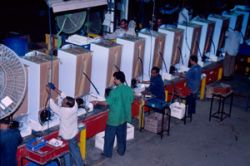
(1) the creation of a process leading to ownership of the HC-technology with the Indian partners; (2) the commercial competitiveness of the HCs; (3) the commitment of all partners at the institutional and human level. Lessons learnt mainly address market failures, the role of the Multilateral Fund (MF) and the growing influence of multinational companies (MNCs). Despite the considerable relevance of Ecofrig to the protection of the Ozone layer, the slowing down of climate change and poverty reduction, there is still unfinished business. The conclusions presented here are based on interviews with Ecofrig programme partners in India, Germany and Switzerland, and a self-assessment by Infras.
|
Output: 12 pp., published in the proceedings to the Conference 'Meeting Challenges in Change over to Ecological Refrigeration', IITD-Conference in New Delhi (India), March 5-6, 2002 Author: Richard Gerster Download PDF: Delhi
|
|||
|
|
||||
|
Green Innovation instead of Resignation
Their implementation required a political climate conducive to innovation. They focused mainly on climate protection, toxic substances, biodiversity and related international conventions. The article summarises core findings in the form of ten hypotheses, each illustrated with examples from practical projects.
|
|
|||

|
|