RESULTS: AID & POVERTY |
|
 |
|
|
Swiss Development Cooperation in Perspective Since 2015, Caritas Switzerland publishes an annual review (“Almanach”) of development policy issues. The first volume is dedicated to “Perspectives of Development Cooperation”. Caritas invited Richard Gerster to contribute an introductory overview on the past decades of Swiss development cooperation (ODA & NGO) and the lessons learned for the future. He concludes that the primary poverty focus of development cooperation is more and more being replaced by broader objectives of international cooperation. On the launching event Richard Gerster presented an opening statement, highlighting the economic and political rise of the developing world during the past decades, the growing role of civil society in the South and the North; the challenges of development cooperation in terms of quantity, quality and coherence; the rise of competing paradigms like migration, global warming and humanitarian aid. Richard Gerster’s article (in German and French) as well as his presentation (in German only) are available below.
|
Output 1: 14 pp. (ppt, in German only) Author: Richard Gerster Download PowerPoint Show (German) Output 2: 47 pp. (in German & French) Author: Richard Gerster Download PDF (German) Download PDF (French)
|
|||
|
|
||||
|
North – South: What have we learned? In March 2014, the Swiss Network for socially responsible business (“Netzwerk für sozial verantwortliche Wirtschaft”, www.nsw-rse.ch) invited to an exchange of views on the topic “North – South: What have we learned?” Walter Fust, former Director of Swiss Development Cooperation (SDC), and Richard Gerster of Gerster Consulting presented opening statements from their perspectives. They highlighted the economic and political rise of the developing world during the past decades, essentially based on its own merits; the complementarity of development cooperation and its limitations; the challenges for a constructive and more coherent role of Switzerland. Richard Gerster’s presentation is available below (in German only).
|
Output: 3 pp. (in German only) Author: Richard Gerster Download PDF
|
|||
|
|
||||
|
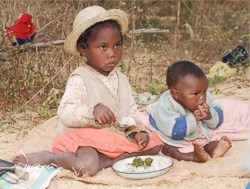
Africa’s Orphaned Generations: Millions of children in Africa have lost one or both parents due to HIV and AIDS, or are confronted by the challenges of poverty and conflict. These vulnerable children face material hardship, socio-economic disadvantage, social stigma, emotional isolation and psychological trauma. Their individual burden poses also a threat to the collective development of the countries affected. For 10 years, the Regional Psychosocial Support Initiative (REPSSI) has developed psychosocial support tools to help children cope with their loss and regain confidence. REPSSI and its partners (Governments, international organizations, NGOs) in 13 countries of Southern and East Africa incorporate these tools into healthcare, poverty alleviation and education programs. REPSSI has notably been supported by the Novartis Foundation for Sustainable Development (NFSD), Swiss Development Cooperation, SIDA and NORAD. A new book by Richard Gerster, “Africa’s Orphaned Generations: It takes more than a village to raise a child" (“Afrikas verwaiste Generationen: wie Kinder von Aidsopfern eine Zukunft erhalten") provides insights into the situation of the affected families and children, and explores the contribution of REPSSI and its partners in building up state-of-the-art psychosocial support. The book in German was published by Orell Füssli, Zurich (see below). The English version is available now for download as an e-book below. The publication has been launched on two occasions in Zurich and Basel:
|
Outputs: (1) English: The e-book „Africa’s Orphaned Generations: It takes more than a village to raise a child” can be downloaded here. Being a free e-book of 120pp., a donation to REPSSl is recommended, for particulars see page 2 of the e-book. (2) German: published by Orell Füssli, Zurich, entitled “Afrikas verwaiste Generationen. Wie Kinder von Aidsopfern eine Zukunft erhalten”, hardcopy SFR 24.90, 160 pp, Bestellung hier Author: Richard Gerster
|
|||
|
|
||||
|
Mutual Accountability in Practice: The Case of Ghana From 29 November to 1 December 2011, in Busan (Korea) delegates review global progress in improving the impact and effectiveness of aid. One of the key principles of aid effectiveness in line with the Paris Declaration and the Accra Agenda of Action is mutual accountability. The recent independent evaluation of the Paris Declaration revealed the implementation of mutual accountability as an almost universal failure. In this context, the case of Ghana is of interest as it started developing a Performance Assessment Framework of Development Partners (DP-PAF) during 2009/2010. The process was supported by Switzerland, at the time Co-Chair of the Multi-Donor Budget Support (MDBS) Group. It has been the idea to include traditional and non-traditional donors in the process, an ambition which remained unfulfilled to a large extent. Gerster Consulting (Switzerland) and the Centre for Policy Analysis (Ghana) had a joint mandate to facilitate and draft the analysis required. An initial introductory paper to underpin the early phase is available below. The main DP-PAF Baseline Report 2008/09 documents in detail the elaboration process and its results. The report can be found at the Ministry of Finance’s (MOFEP) website or can be downloaded below. Ghana is one of several developing countries (like Mozambique or Rwanda) measuring the performance of donors in a precise framework. The DP-PAF as a contextualised national tool but harmonised with the international efforts has the particular merit that it can be continued independently from the decisions taken in Busan. In the information/article section of this website there is a comment (in German) on the appetite for success in development cooperation.
|
Output (1)
Introductory paper: 12 pp Author: Richard Gerster Download PDF Introduction DPs PAF Output (2) DP PAF Baseline 2008/09: 107 pp Authors: Samuel Nii-Noi Ashong Richard Gerster Download PDF Baseline Study
|
|||
|
|
||||
|
Unfinished “Swissness” in Development Cooperation “Swissness” in development cooperation means to put the partner and his needs into the centre, to focus on quality including processes and to make use of comparative advantages of Swiss experience. As part of an earlier research effort, such elements of Swiss quality in development cooperation have been identified by Indian partners in many interviews (see “Swissness made in India”). Richard Gerster’s new article puts this positive appreciation into the wider context of Swiss development policy which is known as one of the least coherent policies among industrialised countries, as evaluated by the Center for Global Development (CGD), or as critically reviewed several times by the DAC-OECD peers. The contradictions of technology policy (patenting), agricultural policy, trade policy, fiscal policy and legal assistance assistance with development priorities of poor countries are numerous. The article is a contribution to the publication “Hunger for Justice. Perspectives to overcome poverty”, available in German only, entitled “Hunger nach Gerechtigkeit. Perspektiven zur Überwindung der Armut”, Helden-Verlag Zürich 2011. Edited by Thomas Groebly, the book was published in honour of ABAI, a Brazilian-Swiss aid organisation founded by Marianne Spiller-Hadorn. The entire book can be bought at info@abai.ch. Our article can be downloaded (in German only) here.
|
Output: 9 pp Author: Richard Gerster Download PDF Swissness (german)
|
|||
|
|
||||
|
Challenges for Swiss Civil Society Organisations in Development Cooperation Non-governmental organisations (NGOs) are facing development effectiveness and efficiency as challenges as well as governments do. In Switzerland, two large NGOs decided to proactively join forces in order to serve the partners in developing and transition countries better. Helvetas and Intercooperation had already been practicing a strategic partnership for the last two years. On April 9, 2011, the annual assembly of Helvetas approved a formal merger of the two NGOs to create a new organisation under the name “Helvetas Swiss Intercooperation”. The foundation council of Intercooperation had voted for the joint new set-up already before. The new NGO is the largest Swiss development NGO. Richard Gerster, non-executive member of the board of directors of Helvetas, had been asked to make a framing presentation to the Helvetas membership and sponsors highlighting the global and national challenges for Swiss NGOs. The presentation is available in German only.
|
Output: 36 pp Authors: Richard Gerster Download PDF: NGO challenges (text only) NGO challenges (photos & titles)
|
|||
|
|
||||
|
Implementing the Right to Food The University of Applied Sciences Northwestern Switzerland (FHNW) hosted a symposium on the occasion of the World Food Day 2010. Among other speakers, Richard Gerster was invited to present his views on the challenges faced by the implementation of the right to food. Starting in Burkina Faso, he analysed the reasons of hunger and malnutrition, followed by experience based policy elements to improve the worrying global situation. The concluding example of Swiss sugar production highlights the conflicts of interest by the different stakeholders involved. The power point presentation can be downloaded in German only.
|
Output: 16 pp Author: Richard Gerster Download PDF Hunger (german)
|
|||
|
|
||||
|
Lessons Learned on how to Promote Innovation in Development Cooperation The International Fund for Agricultural Development (IFAD) has mandated a team in 2009/10 to undertake a corporate-level evaluation of IFAD’s capacity and experience in the promotion of replicable innovations. In this context, Gerster Consulting has been asked to identify benchmarks in terms of good practices of how other comparable organisations promote innovation in development cooperation. The innovative policies and practices of the Humanist Institute for Development Cooperation (HIVOS) in the Netherlands, of Irish Aid, of the International Development Research Centre (IDRC) in Canada, of the United Nations Development Fund for Women (UNIFEM) and of the World Bank have been reviewed. In particular, the research approach covered (1) the understanding of innovation,
|
Output: Main report + annex 1-3: 44 pp Annex 4-8: 65 pp Authors: Richard Gerster & Sonja Beeli Download PDF: PDF IFAD main + Annex 1-3 PDF IFAD annex 4-8
|
|||
|
|
||||
|
Aid Effectiveness: What have we learnt? The Swiss Government had proposed to continue with 0.4% of GDP, and despite the impressive NGO effort, the majority of the People’s chamber of Parliament followed the Government. Now it is up to the second chamber of parliament, the State Council, to approve the framework credits for development cooperation. In view of that decision the Foreign Policy Committee of the State Council of the Swiss Confederation held hearings on June 19, 2008. Among other experts, the Foreign Policy Committee invited Richard Gerster to testify on the effectiveness of Swiss foreign aid. You can download his presentation as a PDF-file (in German only).
|
|
|||
|
|
||||
|
Partners in Development: India and Switzerland
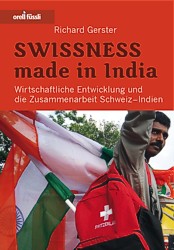
It aims at answering questions such as „What characterises Swiss development cooperation in India?“, „What has been achieved?“ and „What are the lessons learned?“ The book is based on some 250 interviews with Indian partners, former and current Swiss employees, independent observers in both countries as well as on numerous documents and publications. In spite of its small size Switzerland managed to become known as an influential niche player in India. Swiss contributions in areas such as animal husbandry or dairy farming, disaster prevention, rural housing, drinking water, microfinance or infrastructure financing have had an impact not only at the local level, but also at the state level – they even influenced national policies for 1,1 billion people. Experiences from development cooperation in India had reciprocal influences on Swiss programmes in other countries. Overall, both the Government and NGOs have reached much more than could realistically be expected. These successes are those of the Indian partners. Forewords by Micheline Calmy-Rey, Swiss Minister for Foreign Affairs, and M.S. Swaminathan, M.P. and President M.S.Swaminathan Research Foundation. This timely publication is highly relevant for the forthcoming decisions by the Swiss Parliament to shape the future contribution of Switzerland to development cooperation.
|
Output: (1) in English by Social Science Press, Delhi in cooperation with Berghahn Books, Oxford/New York, entitled “Partners in Development. India and Switzerland”, USD 75, 154 pp, (Link) (2) In French by Editions Favre, Lausanne, ”La coopération entre la Suisse et l’Inde. Au dela des clichés de la pauvreté et du miracle économique”, CHF 33, 192 pp, (Link) (3) in German by Orell Füssli Verlag, Zurich, entitled „Swissness made in India. Wirtschaftliche Entwicklung und die Zusammenarbeit Schweiz – Indien“, CHF 34.80, 156 pp, (Link) Author: Richard Gerster
|
|||


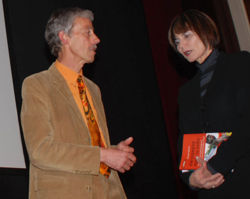
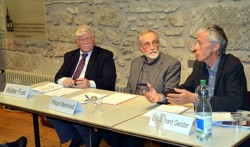 Philippe Mastronardi (facilitator) with Walter
Fust (left) and Richard Gerster (right)
Philippe Mastronardi (facilitator) with Walter
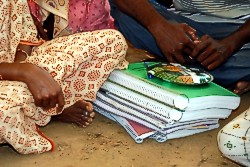
Fust (left) and Richard Gerster (right)  School children drawing in their hero book
(Uganda)
School children drawing in their hero book
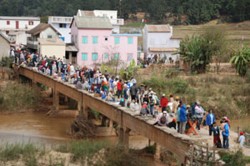
(Uganda) 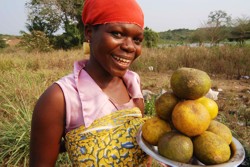 Mutual accountability for the people (photo: fruit
vendor in Ghana)
Mutual accountability for the people (photo: fruit
vendor in Ghana) 

|
|
|||||
|
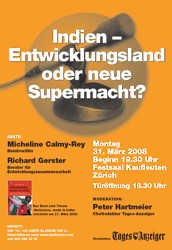
India – Developing Country or Superpower?
|
Download PDFs (German): Presentation by Micheline Calmy-Rey Presentation by Richard Gerster
|
||||
|
|
|||||
|
Action Plan to Address Agrarian Distress in India
In this initiative, NABARD has been supported by the Swiss Agency for Development and Cooperation (SDC). NABARD nominated as members of the expert panel M.S. Sriram, IIM Ahmedabad; P.K. Joshi, NCAP Delhi; Satish Chander, Ministry of Agriculture; Malcolm Harper, UK; Konrad Matter, Switzerland; Richard Gerster, Switzerland. The panel focuses on the issues of finance, risk mitigation, social support mechanisms, and farm practices. The panel report can be found at NABARD’s website or can be downloaded on the right.
|
Output: 42 pp. Author: Independent Expert Panel Download PDF: Agrarian Distress
|
||||
|
|
|||||
|
Lessons Learned about Field Presence
Arrangements
In the international debate on aid effectiveness the influence of internal arrangements on the donor side is often neglected. The International Fund for Agricultural Development (IFAD) has mandated a team to undertake a corporate-level evaluation of IFAD’s Field Presence Pilot Programme (FPPP) in 2006/07 (download PDF here). In this context, Gerster Consulting has been asked to identify good practices of field presence arrangements by other comparable organisations as an instrument for learning. The headquarters – field relations of Action Aid International (AAI), the Asian Development Bank (AsDB), the Food and Agriculture Organisation of the United Nations (FAO), the International Food Policy Research Institute (IFPRI), the Swiss Agency for Development and Cooperation (SDC), and occasionally other organisations have been reviewed. In particular, the research approach covered four strategic dimensions of field presence: (1) implementation support, (2) policy dialogue, (3) partnership building, and (4) knowledge management. As cross-cutting concerns the study pays attention to: (1) the cost-effectiveness of the headquarters – field arrangement, (2) capacity development, and (3) innovation, replication and up-scaling. The study can be downloaded on the right.
|
Output: Main report + annex 1-3: 45 pp., Annex 4-9: 97 pp. Authors: Richard Gerster & Sonja Beeli Download PDFs: IFAD main + Annex 1-3, IFAD annex 4-9
|
||||
|
|
|||||
|
Poverty Observatory in Mozambique The Poverty Observatory in Mozambique was launched in 2003 to enhance citizen participation and social accountability processes in implementing and monitoring Poverty Reduction Strategies. The Swiss Agency for Development and Cooperation (SDC) and the Participation and Civic Engagement Team in the Social Development Department of the World Bank have mandated Gerster Consulting to prepare an assessment of its strengths and weaknesses. The authors Konrad Matter (Switzerland) and Antonio Francisco (Mozambique) provide a detailed description and analysis of the Poverty Observatory in Mozambique. Besides being a very informative piece of work, a relevant feature in the report is its clear identification of different perspectives on participatory mechanisms, as well as the potential of the Poverty Observatory in the future. The study can be downloaded here.
|
|
||||
|
|
|||||
|
New Sources of Development Financing
These estimates suggest roughly a doubling of Official
Development Assistance (ODA). It is not only the amounts that
matter, time also counts: reaching the MDGs by 2015 calls for
rapid increases of public finance for development. This working
paper of the Swiss Agency for Development and Cooperation (SDC)
examines the options of resource mobilisation beyond ODA. In
particular global taxes (Tobin Tax, carbon tax, etc.) and
financial engineering proposals (International Financial
Facility, Special Drawing Rights) are discussed, highlighting
their strengths and weaknesses, and presenting Swiss
perspectives.
|
|
||||
|
|
|||||
|
Private sector development in the context of
poverty reduction strategy papers
There are concrete opportunities for donor action in: promoting effective participation of all stakeholders in elaborating PSD strategies; supporting local governments in improving enabling conditions for PSD; and directly promoting SME development. Furthermore, ways of improving the representation of PSD in PRSPs need to be investigated.
|
Output: 19 pp. Authors: Niklaus Eggenberger-Argote Download PDF: PSD in the PRSP context
|
||||
|
|
|||||
|
Private Sector Development in PRSPs: Stimulating Market Forces or Increasing State Interventions? The Case of Tanzania
An outline of donor-financed PSD activities throws light on the orientation of international donors in this regard.
|
Output: 13 pp. Author: Niklaus Eggenberger-Argote Download PDF: PSD in PRSPs: Market vs. State
|
||||
|
|
|||||
|
Informal Sector Support and Poverty Reduction
This paper, written as a desk study on behalf of the Swiss State Secretariat for Economic Affairs (seco), provides a deeper insight into the relevant causes of informal sectors, the macro-level interventions needed to promote the formalisation of the informal economy, and the steps required to assist informal sector entrepreneurs within the informal sector.
|
Output: 15 pp. Author: Niklaus Eggenberger-Argote Download PDF: Informal Sector & Poverty Reduction
|
||||
|
|
|||||
|
Two Worlds: 2010 vs. 2004 (English & German)
The Swiss Agency for Development and Cooperation (SDC) invited Gerster Consulting to present a critical assessment of the agency's behaviour. In the mood of fortune telling, we portray the contrast between the situation in the year 2010 and the past in 2004. The Power Point Presentation can be downloaded in English and German.
|
Output: 27 pp., power point presentation produced for the Swiss Agency for Development and Cooperation Author: Richard Gerster Download PDFs: 2010 vs. 2004 (English) 2010 vs. 2004 (German)
|
||||
|
|
|||||
|
Sri Lanka: An Independent Assessment of the Comprehensive Social Development Programme of the Sarvodaya Movement
Sarvodaya has a country-wide network. No other organisation on the island can even dream of being so well linked to the people all over Sri Lanka. The Comprehensive Social Development Programme (CSDP) targets 1032 villages in a multi-ethnic environment of 12 Sarvodaya districts. This assessment was done on the joint request of the Sarvodaya Movement and Novartis Foundation for Sustainable Development. Novartis Foundation is co-financing the CSDP from 2000 to 2005.
|
Output: 60 pp., unpublished research Author: Richard Gerster Download PDF: CSDP
|
||||
|
|
|||||
|
Services for the Poor? A Comment on the World Development report 2004
Richard Gerster was invited to present a critical appraisal of the results. A panel then discussed the relevance and conclusions of the WDR 2004 and related them to experiences of Swiss Development Cooperation in Peru and Tajikistan. Is good governance the key to improved services for the poor? How far does the history of industrialised countries matter? What alternatives for reform exist? Is there a convincing case for privatisation of basic services? Such and other questions are dealt with in the presentation made by Richard Gerster.
|
Output: 6 pp. Author: Richard Gerster Download PDF: Services for the Poor?
|
||||
|
|
|||||
|
Synthesis Report on Switzerland's Involvement in the Poverty Reduction Strategy Paper (PRSP) Processes
(1) an SDC-wide survey of SDC´s experience of PRSPs to date; (2) case studies in four SDC partner countries (Kyrgyz Republic, Burkina Faso, Nicaragua, Vietnam) to look in detail at the interactions in PRSP processes; (3) a synthesis report, based on the survey and the case studies, analysing the findings and making recommendations to SDC on how to improve its role in the PRSP processes. Not only the synthesis, but also the earlier case studies on Burkina Faso and Kyrgyz Republic, as well as the initial SDC-wide survey can be downloaded on the right.
|
Output: 61 pp. Authors: Tony German, Richard Gerster, Judith Randel, Sonja Zimmermann Download PDF: Evaluation report
|
||||
|
|
|||||
|
Burkina Faso: The Involvement of Swiss Cooperation in the Development of the Poverty Reduction Strategy Paper (PRSP)
The evaluation comprised: (1) an SDC-wide survey of SDC´s experience of PRSPs to date; (2) case studies in four SDC partner countries (Kyrgyz Republic, Burkina Faso, Nicaragua, Vietnam) to look in detail at the interactions in PRSP processes; (3) a synthesis report, based on the survey and the case studies, analysing the findings and making recommendations to SDC on how to improve its role in the PRSP processes. Not only the synthesis, but also the earlier case studies on Burkina Faso and Kyrgyz Republic, as well as the initial SDC-wide survey can be downloaded on the right.
|
Output: 47 pp. Authors: Richard Gerster and Kimseyinga Sawadogo Download PDFs: Independent Evaluation of SDC's Bilateral Engagement in the Poverty Reduction Strategy Paper (PRSP) Process
|
||||
|
|
|||||
|
Kyrgyz Republic: The Involvement of Swiss Cooperation in the Development of the National Poverty Reduction Strategy
|
Output: 35 pp. Authors: Richard Gerster and Roman Mogilevsky Download PDF: Report PRSP Kyrgyz Republic
|
||||
|
|
|||||
|
A Survey on the Involvement of Swiss Cooperation in the Development of Poverty Reduction Strategy Papers (PRSPs)
|
Output: 51 pp. Authors: Tony German, Richard Gerster, Judith Randel, Sonja Zimmermann Download PDF: Survey Poverty Reduction Strategy Papers
|
||||
|
|
|||||
|
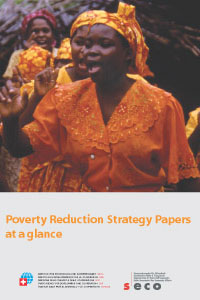
Poverty Reduction Strategy Papers (PRSP) at a Glance
For poor countries, the PRSPs are one of the keys to gaining access to World Bank and International Monetary Fund resources. The process provides both opportunities and risks. Is the PRSP-process flexible enough to respect differing perspectives on growth, distribution and structural policies? Ten elements of the Swiss position towards PRSPs are presented.
|
Output: 8 pp. brochure, published jointly by the Swiss Agency for Development and Cooperation (SDC) and the State Secretariat for Economic Affairs (seco), Berne (Switzerland). Available in English, French, Spanish and Russian. Download PDF: PRSP
|
||||
|
|
|||||
|
Employment to Fight Poverty
"Employment to fight poverty" portrays Swiss supported activities regarding vocational training, the promotion of small enterprises, microcredits, agriculture and forestry as major employers in Africa, Asia and Latin America. An illustrative research done in view of the World Social Summit +5 in Geneva 2000.
|
Output: Brochure of 12pp., in English, French, German, Italian Authors: Richard Gerster Order from sabine.brueschweiler@deza.admin.ch
|
||||
|
|
|||||
|
Alternative Approaches to Poverty Reduction Strategies. A Review of the World Bank Compared to Other Donors
In particular, the study looks at the World Bank's poverty reduction strategy in the light of what other donors are doing. The review served as background to an evaluation by the Operations Evaluations Department (OED) of the World Bank of the effectiveness of the strategy
|
Output: 40pp. Authors: Richard Gerster (Gerster Consulting), with contributions by Judith Randel and Tony German (Development Initiatives), United Kingdom Download PDF: Alternative Approaches to Poverty Reduction Strategies
|
||||
|
|
|||||