SERVICE: POLICY
|
|
 |
|
Good policies and their implementation are a matter of survival. This was a bitter lesson of the
financial crisis. We have seen so many development efforts and cooperation projects suffocated by
diminishing financial and policy space.
The lessons learnt from the economic, political and social history
of Switzerland and their relevance for development policy in the
21st century are not a recipe book for success in development but
may be an interesting and complementary source of policy advice.
Policy analysis and advice, with the perspective of
(1) pro-poor policies and
(2) the provision of public goods are our core concerns.
Experience tells us that regional economic integration is
often at least as promising as a forced orientation towards
global markets. Moreover, a regional perspective is usually more
sound on environmental grounds. Keeping this in mind, the
following areas are at centre stage in our activities:

|
|
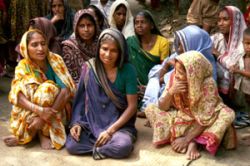
| Listening to the people is the best ground for pro-poor
policies |
|
 |
|
Poverty
The instrument of the Poverty Reduction Strategy (PRS) owned by
all stakeholders is an opportunity for a pluralistic approach, opening up space for
non-mainstream pro-poor policies. Pro-poor policies are a priority
for more than social sectors like health and education. Poverty
reduction is as much a concern of the productive and private sector
to generate income and jobs.

|
|
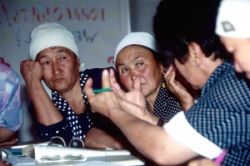
| Community based tourism is one of the rare opportunities
to create non-agricultural income in rural Kyrgyzstan
|
|
 |
|
Trade
We are prepared to contribute to processes that facilitate the penetration
of world markets by developing and transition countries, so that
they get their fair share in globalisation, and to processes that
lead to their empowerment in the multilateral trade system. Pure
growth strategies should be modified to include distributional aspects,
in order to arrive at effective pro-poor policies. Fair trade
opportunities deserve special attention.

|
|
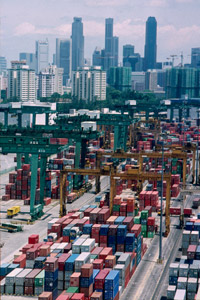
| The world's largest container terminal in Singapore
|
|
 |
|
Finance
The policies followed by poor and aid-dependent developing and transition
countries are to a large extent shaped by the policies of the Bretton
Woods Institutions (World Bank, International Monetary Fund). We
share the view that a new international financial architecture –
including a Fair and Transparent Arbitration Process and revised
governance in the Bretton Woods Institutions – is required in the
interests of developing and transition countries.

|
|
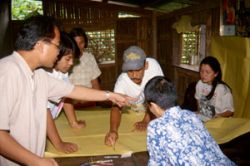
| Participative Planning is crucial |
|
 |
|
Environment
The global economy, with its focus on economies of scale, its specialisation
and monocultures, as well as the increasing concentration on economically
strong regions, puts our climate and the environment under stress – and highlights at the same time the
alternative approach based on livelihoods, multifunctionality and diversity. Making market forces
preventively work for the preservation of our climate and environment, and implementing the ´polluter-pays principle´
are among our working approaches to keeping or restoring a sound
environment for future generations.

|
|
| Nature and industry in harmony? Giraffes on a cement industry's compound in Kenya |
|
 |
|
Information and Communication Technologies (ICTs)
The new information and communication technologies (ICTs) – a
revolution for whom? In Geneva, 2003, and in Tunis, 2005, the
World Summit on the Information Society (WSIS) took place. An
enabling environment in ICT policy and implementation to boost
economic growth and poverty reduction is desperately needed. Its potential is well illustrated by the
triumph of mobile phones in Africa.

|
|
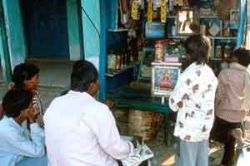
| The community is watching TV in a village in India's Narmada
valley |
|
 |
|
Globalisation
The dominating pattern of globalisation is shaped by the economic
leaders of the North and shaped to their benefits. New trade rules,
a new financial architecture, new forms of multilateral governance,
new roles for the private sector - including its corporate
social responsibilities - are required to address poverty and inequity effectively at the
regional, national and global level.

|
|
| A global vision of the world, inclusive of the East and
West, North and South, is required |
|
 |
|
Beyond these areas we have experience in dealing with a
range of issues, as diverse as migration and social development.
In recognition of the quality of our policy advice Richard Gerster became a member of the Development Cooperation
Advisory Council to the Minister of Foreign Affairs of the Republic
of Austria.
Some of the outputs of our policy advice are accessible under
the results section.
On request, references for further policy development work undertaken
can be quoted.

|
|
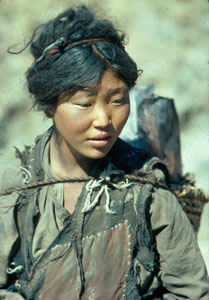
| Policies have a human face: A Tibetan refugee in Nepal
|
|
 |